
By: Kallie Kurtz, LCSW/LICSW, JD/DSW Candidate · The RAINE Lab at Grove Institute
What if the people our behavioral health system misses most are not “hard to reach”? What if we have been reaching for them in the wrong place?
That question is why we piloted Bilateral Kinetic Processing (BKP). It is not just a new technique. It is an attempt to reimagine where and how behavioral health happens, so we can finally meet the people most at risk and least served by care as it exists today.
Why reimagine behavioral health at all?
Most therapy still looks the same: two people, two chairs, four walls, fifty minutes. For many people that works. But the science that could help far more people already exists, and it lives in separate silos:
- Nature calms the amygdala and supports emotional regulation.
- Rhythmic movement supports neuroplasticity and lowers distress.
- Bilateral stimulation, the side-to-side rhythm at the heart of EMDR, helps the brain process and integrate.
- Evidence-based therapy like CBT, ACT and CPT gives people tools that last.
These pieces almost never show up in the same session. The result is what we call a biological bottleneck: we ask the thinking brain to do careful work while the body is still braced for threat. For a lot of people, sitting still in an office is exactly what keeps the door closed.
The four-wall model
- Sitting still while the nervous system is on high alert
- Face-to-face eye contact that can feel like pressure
- Talking first, regulating maybe
- Only reachable inside a clinic, during clinic hours
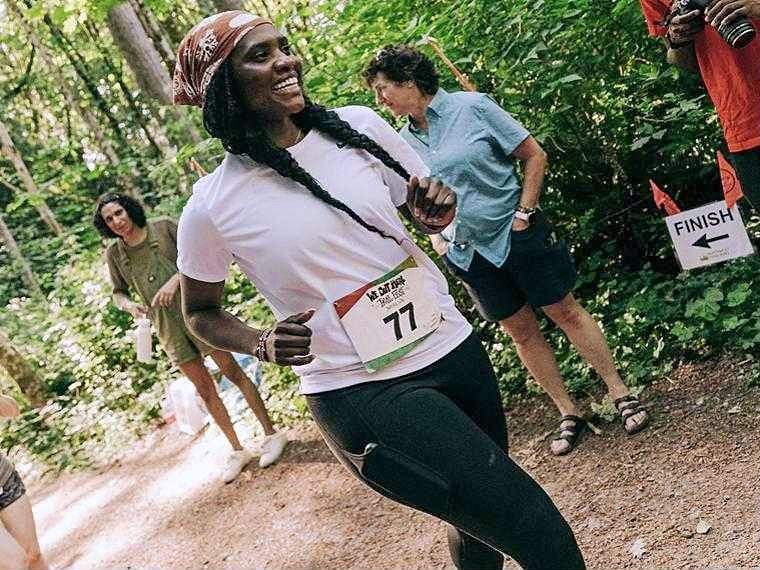
Bilateral Kinetic Processing
- Moving with rhythm, so the body can settle
- Side by side on a trail, eyes on the horizon
- Regulating and processing at the same time
- Happens on public lands, in community, outside
The people we keep missing
The gap is widest for the very people who carry the heaviest load. These groups often face the highest risk, including suicide risk, and the greatest day-to-day impact on their lives, yet they are the least served by the “sit and talk” model.
Neurodivergent people
People with ADHD and other diverse cortexes, who may think best while moving and struggle to stay still in a chair.
Survivors of violence and abuse
Including survivors of domestic violence and systemic abuse, whose bodies stay braced long after the danger is gone.
Spanish-speaking patients
Who too often find care that is not offered in their language or shaped around their lives.
People raised not to show it
From cultures and communities where emotional vulnerability is discouraged, and sitting across from a stranger to talk about feelings does not fit.
Everyone outside the system
The huge share of people worldwide who carry real distress and trauma but live beyond the reach, or the cultural relevance, of traditional clinics.
We borrow a word from Kimberlé Crenshaw here: intersectionality. She coined it to describe how overlapping identities and systems of power shape people’s lives. Applied to care, it means refusing to keep the pieces of healing in separate boxes. Nature, movement and clinical skill belong together, delivered where people actually are.
Minding the gap
Skiers have a phrase, “minding the gap,” for the space between what you know and what you still have to learn. This project started there.
I grew up in Alaska on rivers, ridges and Nordic ski trails. Running, skiing and long days outside were how I managed my own ADHD and trauma long before I had clinical words for it. As a clinician, I kept hearing the same thing from clients: their breakthroughs happened on walks, on the water, on the trail. Not in the office.
But those breakthroughs sat outside the evidence base, which made them hard to bill for, hard to teach and hard to scale. So I founded the RAINE Lab to start measuring them.
Four pillars, one session
Nature is good for the brain. Movement is good for the brain. Bilateral stimulation is good for the brain. Therapy is good for the brain. BKP layers all four into a single encounter.
Nature · the sensory anchor
Green spaces act like a co-therapist, lowering the body’s baseline and quieting rumination.
Movement · the cognitive prime
Walking, paddling or cycling shifts the brain from stuck to flexible.
Bilateral rhythm · the integrator
Cross-body rhythm supports processing hard memories and bridges executive function differences common in ADHD and autism.
Clinical processing · the layered signal
CBT, ACT and CPT delivered on top of a more regulated nervous system.

How the pilot worked
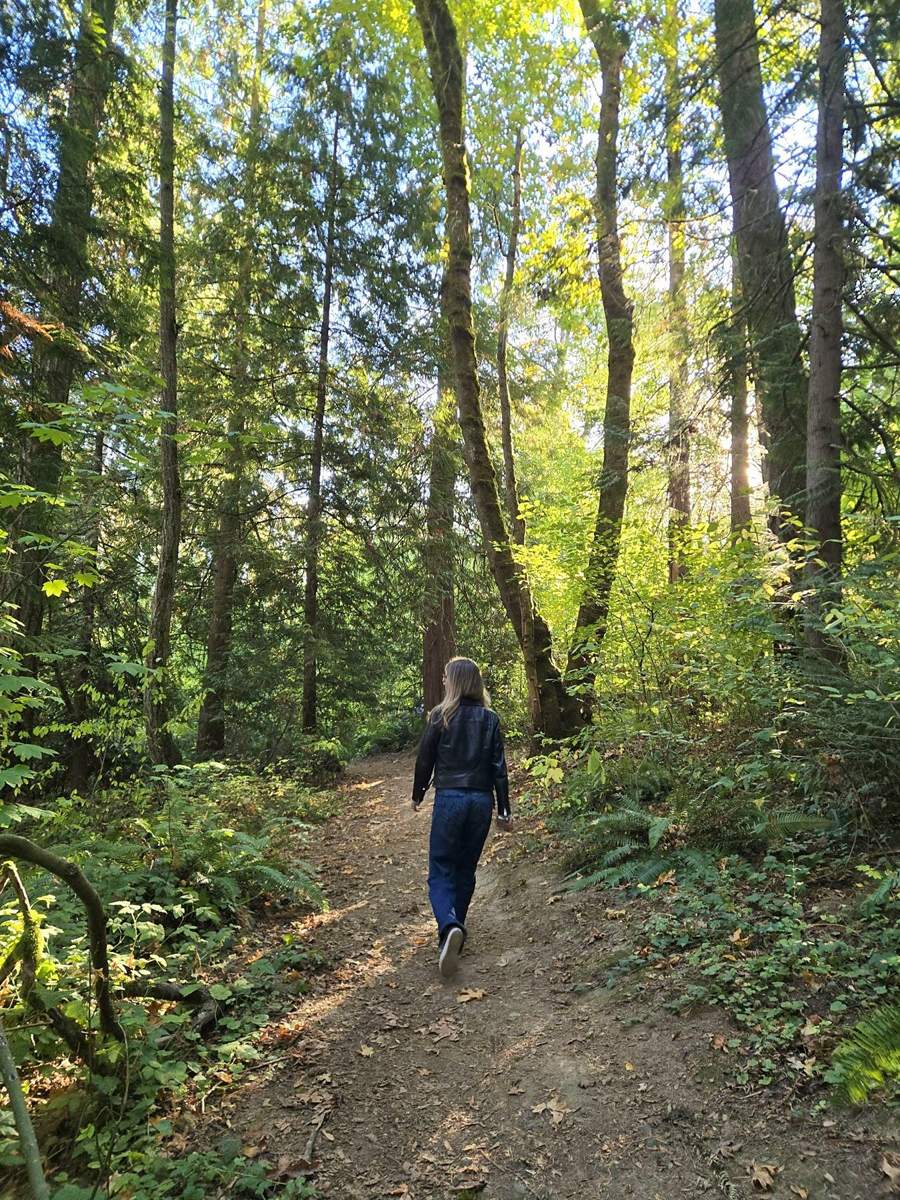
This was a quality improvement (QI) pilot in community-based outdoor settings, mostly on public lands. Every participant had a formal ADHD or trauma diagnosis or showed significant ADHD traits.
Learn
A short orientation on how nature, movement and bilateral rhythm affect the brain.
Check in
Name the feeling, rate its intensity (0–10) and rate mood (1–5).
Move + process
30 minutes of rhythmic movement they chose, outdoors, with a licensed clinician guiding CBT, ACT or CPT.
Check out
Answer the same questions again, right away.
We tracked 51 sessions. All data was de-identified and reported only in aggregate.
What we found
People arrived carrying a lot: over two-thirds (68.6%) rated their intensity at 6 or higher. Thirty minutes later, the picture looked very different.
The most common distress rating dropped from 7 to 3
Most frequent intensity rating on a 0–10 scale, before and after a 30-minute BKP session
After the session, 64.8% rated their intensity at 3 or lower.
High distress fell by more than two-thirds
Share of sessions rated 7–10 out of 10
Good moods nearly quintupled
Share of sessions reporting a good or excellent mood
No one gave the top mood rating before. After, 25.5% did.
From overwhelmed to calm
Most-reported feelings, share of sessions
Before the session
After the session
See the data as a table
| Measure | Before | After |
|---|---|---|
| High distress (7–10) | 39.2% | 11.7% |
| Low distress (3 or lower) | not reported | 64.8% |
| Most common distress rating | 7 | 3 |
| Good or excellent mood | 13.7% | 66.7% |
| Top mood rating | 0% | 25.5% |
| Most common feeling | Overwhelmed (45.1%) | Calm (47.1%) |
The Simultaneous Effect
These were not relaxing nature walks. People were doing real clinical work, sometimes hard trauma work, while they moved. And yet two things happened in the same 30 minutes:
Distress went down
Mood went up
In a typical office session, digging into something painful often leaves people feeling worse before they feel better. These results suggest that when the body is moving and the senses are anchored outdoors, the nervous system can stay inside its window of tolerance while the mind does the heavy lifting. That opens the door to deeper work with less risk of flooding, burnout or sensory overload.
Good for the clinician, too
Burnout and vicarious trauma are pushing clinicians out of this field just when we need them most. In BKP the clinician is outside and moving too, likely getting some of the same regulating benefits as the client. A model that keeps clinicians well keeps more of them in the work, and that means more care for more people.
Safety and consent
Informed consent
Written consent for the session and for anonymous use of data, with the right to stop or opt out anytime.
Privacy on the trail
A simple script let anyone switch to a neutral topic or pause if someone walked by.
Planned safety points
Clinicians prepared grounding skills and pre-planned stopping points along each route.
Ethics
Run as a QI initiative and determined exempt from formal IRB review, with ethical standards kept throughout.
What this pilot does and does not show
We want to be honest about the limits. This was not a controlled or randomized study. Weather, the type of movement and starting stress levels all varied. Participants volunteered, and the ratings are self-reported in the moment. Fifty-one sessions is a strong early signal, not proof for everyone.
That is what a pilot is for. It tells us this is worth studying at a much larger scale, and that is exactly where we are headed.
Where we go from here
Our goal is to build the evidence that makes BKP a recognized best practice, so providers everywhere can learn it and clients can use their insurance for it. Just as important, we want these principles to reach people outside clinical spaces altogether: in schools, on teams, in communities and on the trail.
Behavioral health does not have to wait for people to walk through a clinic door. It can meet them where they already are: outside, on the move, off the couch.
References
Barton, J., & Pretty, J. (2010). What is the best dose of nature and green exercise for improving mental health? A multi-study analysis. Environmental Science & Technology, 44(10), 3947–3955. https://doi.org/10.1021/es903183r
Crenshaw, K. (1989). Demarginalizing the intersection of race and sex. University of Chicago Legal Forum, 1989(1), 139–167.
Hillman, C. H., Erickson, K. I., & Kramer, A. F. (2008). Be smart, exercise your heart: Exercise effects on brain and cognition. Nature Reviews Neuroscience, 9(1), 58–65. https://doi.org/10.1038/nrn2298
Hunter, M. R., Gillespie, B. W., & Chen, S. Y.-P. (2019). Urban nature experiences reduce stress in the context of daily life based on salivary biomarkers. Frontiers in Psychology, 10, 722. https://doi.org/10.3389/fpsyg.2019.00722
Payne, P., Levine, P. A., & Crane-Godreau, M. A. (2015). Somatic experiencing: Using interoception and proprioception as core elements of trauma therapy. Frontiers in Psychology, 6, 93. https://doi.org/10.3389/fpsyg.2015.00093
Porges, S. W. (2011). The polyvagal theory: Neurophysiological foundations of emotions, attachment, communication, and self-regulation. W. W. Norton & Company.
Ratey, J. J., & Hagerman, E. (2008). Spark: The revolutionary new science of exercise and the brain. Little, Brown and Company.
Sudimac, S., Sale, V., & Kühn, S. (2022). How nature nurtures: Amygdala activity decreases as the result of a one-hour walk in nature. Molecular Psychiatry, 27, 4446–4452. https://doi.org/10.1038/s41380-022-01720-6
van der Kolk, B. A. (2014). The body keeps the score: Brain, mind, and body in the healing of trauma. Viking.