
DIAGNOSTICS & BEHAVIORAL HEALTH ASSESSMENTS
As licensed clinical social workers, our clinicians are qualified to provide comprehensive behavioral health assessments that identify symptoms, functional impacts, and psychosocial factors contributing to emotional or behavioral concerns.
These assessments are conducted within our professional scope of practice and may include the use of standardized screening tools, clinical interviews, and behavioral observations. When appropriate, we assign behavioral health diagnoses using the DSM-5-TR for the purposes of treatment planning, coordination of care, or insurance documentation.
Our assessments are holistic and trauma-informed, considering the biological, psychological, social, and environmental systems that shape each person’s behavioral health. When needed, we collaborate with primary care providers, psychiatrists, or other specialists for medication evaluation, neuropsychological testing, or medical rule-outs.

DIAGNOSTIC ASSESSMENTS
& LEGAL SCOPE of PRACTICE
Here at Grove, we currently have Licensed Independent Clinical Social Workers (LICSW/LCSW), who are legally authorized under Washington and Oregon law (RCW 18.225 and OAR 877-020-0008) to:
-
Assess, diagnose, and treat mental, emotional, and behavioral health disorders using the DSM-5-TR (Diagnostic and Statistical Manual of Mental Disorders).
-
Conduct clinical evaluations and treatment planning using evidence-based and trauma-informed methods.
-
Administer, score, and interpret standardized clinical measures to support assessment and monitor treatment outcomes.
There are validated clinical measures for all behavioral health conditions—including mood, anxiety, trauma, attention, substance use, psychotic, and personality disorders. These instruments help ensure that diagnoses are accurate, consistent, and measurable. Examples include:
-
PHQ-9 (Depression)
-
GAD-7 (Anxiety)
-
PCL-5 (PTSD)
-
ASRS (ADHD)
-
AUDIT/DAST (Substance Use)
-
WHODAS 2.0 (Functional Impairment)
-
OQ-45 or CORE-OM (Treatment Outcomes)
Using these instruments ensures that assessment and treatment are grounded in
both clinical science and the lived reality of each individual.
Diagnostic clarification
& treatment planning
Comprehensive
behavioral health & psychosocial assessments
Functional & symptom-based evaluation for anxiety, depression, trauma, & ADHD
Coordination with medical
or psychiatric providers
when appropriate
OUR COMMITMENT
At Grove, diagnostic work is more than identifying symptoms—it’s about understanding the full picture of who you are. By combining neuroscience, social context, and lived experience, we build a comprehensive understanding that guides individualized treatment and healing.
Every diagnostic process at Grove reflects the belief that mental and behavioral health are not defined by what is “good” or “bad,” but by how your mind and body have adapted to the world around you—and how, together, we can help them heal.
COLLABORATION & REFERRAL FOR SPECIALIZED TESTING
Some psychological or neuropsychological instruments—such as IQ tests, cognitive batteries, or personality inventories like the MMPI-2—are classified by test publishers as Level C instruments, which require administration and interpretation by a doctoral-level psychologist (PhD or PsyD) with advanced psychometric training.
If a test or assessment you’re seeking falls into that category—or outside the LICSW/LCSW scope of practice—we will coordinate or refer directly to one of the psychologists we collaborate with to ensure you receive the care and evaluation you’re looking for.
This collaborative approach allows each professional to practice within their licensed authority while ensuring that your diagnostic process is complete, ethical, and effective.

UNDERSTANDING BEHAVIORAL HEALTH CONDITIONS
At Grove Institute, we use an integrated, evidence-based framework to understand how mental and behavioral health conditions develop and heal. This model recognizes that human behavior is shaped by multiple, interconnected systems:
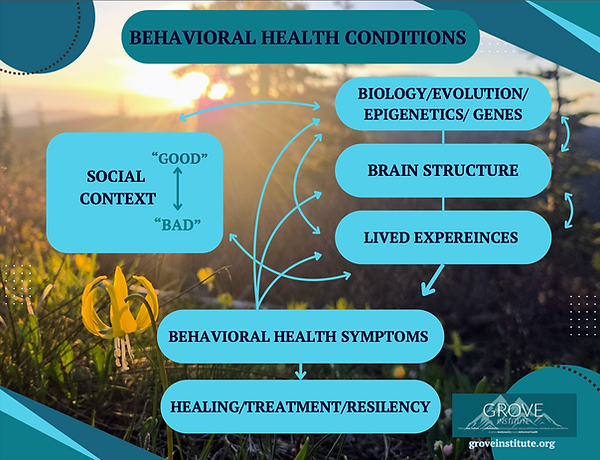
Biology, evolution, genes, & epigenetics
how our physiology and inherited traits influence emotion, mood, brain structure and stress responses
Brain structure
& function
how neural pathways and regulation systems form and adapt across time and across individuals
Social contexts
how culture, systems, and stigma influence what is defined as “healthy,” “unhealthy,” or “disordered” and how living in a hierarchical “good/bad” system shapes us
Lived experiences
including trauma, attachment, relationships, identity,
and environment
Behavioral health symptoms arise from the interaction of these systems.
Healing involves understanding those relationships and restoring regulation, connection, and meaning.